The Nine Nights of Shakti: A Celebration of the Divine Mother
While the world may pause for a day to honour women and another day to celebrate the unconditional love of mothers, Indian tradition offers something deeper—nine sacred nights devoted to the cosmic feminine.
Today begins Navratri, a festival that doesn’t just worship a goddess—it immerses us in the living pulse of Shakti (= power) herself. She is a mother, a sister, a daughter, a partner, a mentor; the quiet breath of dawn and the thunderclap of transformation.
These nights are more than ritual—they’re a spiritual homecoming. A time to dance, reflect, fast, and feel. In this post, we’ll walk through the mythic origins of Navratri, revisit a bold childhood moment from Swami Vivekananda, explore how India celebrates from Kolkata’s pandals to Gujarat’s Garba, and discover the colours that guide each day of devotion.
The Legend of Mahishasura Mardini
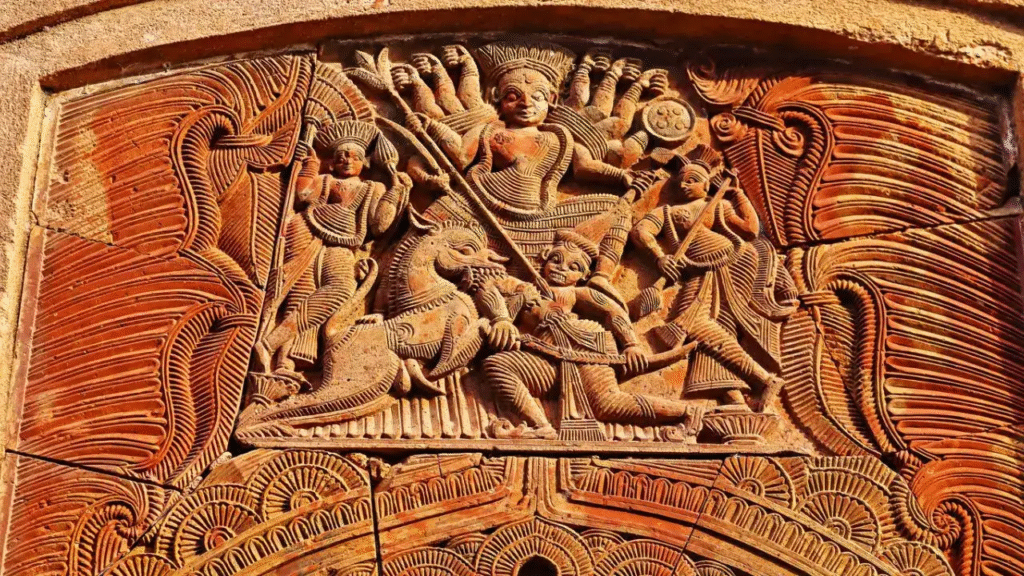
Mahishasura, a shape-shifting buffalo demon, was born of both brute strength and cunning. Through intense penance, he earned a boon that no man or god could kill him—a loophole he exploited to unleash chaos across heaven and earth. Drunk on power, he dethroned Indra (the king of gods), terrorized sages, and disrupted cosmic balance.
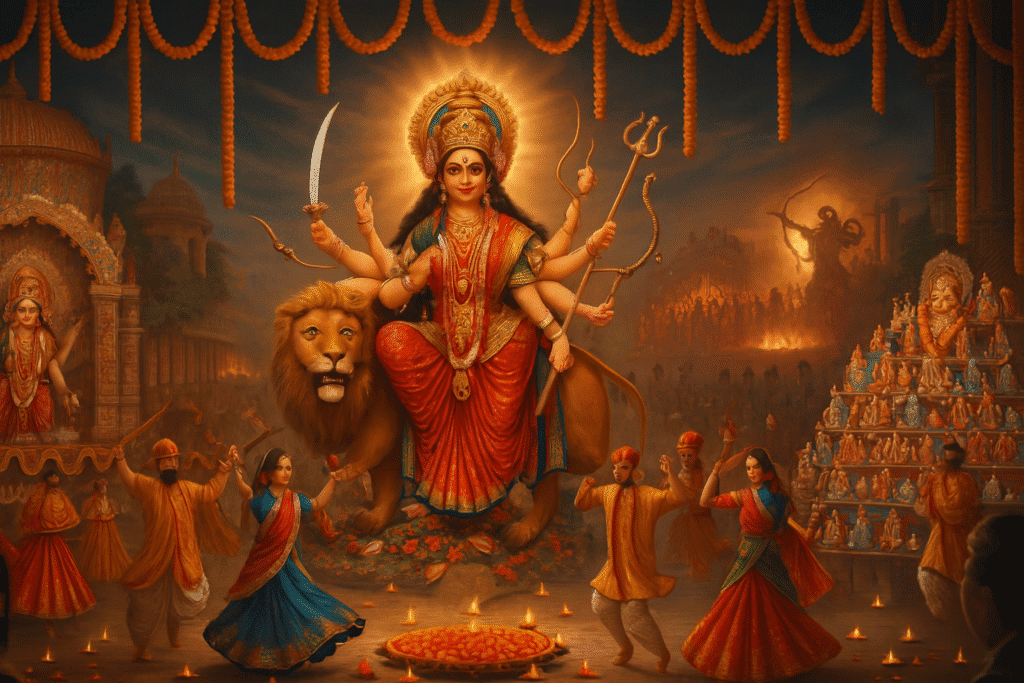
The gods, helpless against his tyranny, turned to the Holy Trinity—Brahma, Vishnu, and Mahesh (Shiva). In a moment of divine convergence, Brahma, Vishnu, and Shiva fused their energies to create Goddess Durga—a radiant warrior embodying their collective might. Riding a lion and armed with celestial weapons gifted by the gods—Shiva’s trident, Vishnu’s discus, Indra’s thunderbolt—she descended into battle, fierce, radiant, and unstoppable.
As chronicled in the Devi Mahatmyam from the Markandeya Purana, a ferocious nine-day battle ensued. Mahishasura, ever deceptive, morphed from buffalo to lion to elephant, trying to outwit her. But on the ninth night, as he returned to his buffalo form, Durga pinned him down with her foot and, with a triumphant roar, severed his head with her sword.
Her victory on the tenth day—Vijayadashami—restored peace to heaven and earth. And so, Navratri commemorates this epic war: nine nights of divine struggle, culminating in the triumph of good over evil. It’s not just a legend—it’s a living reminder that even the darkest forces can be overcome by courage, unity, and divine grace.
The Spirit of Courage Beyond the Myth: A Story of Swami Vivekananda
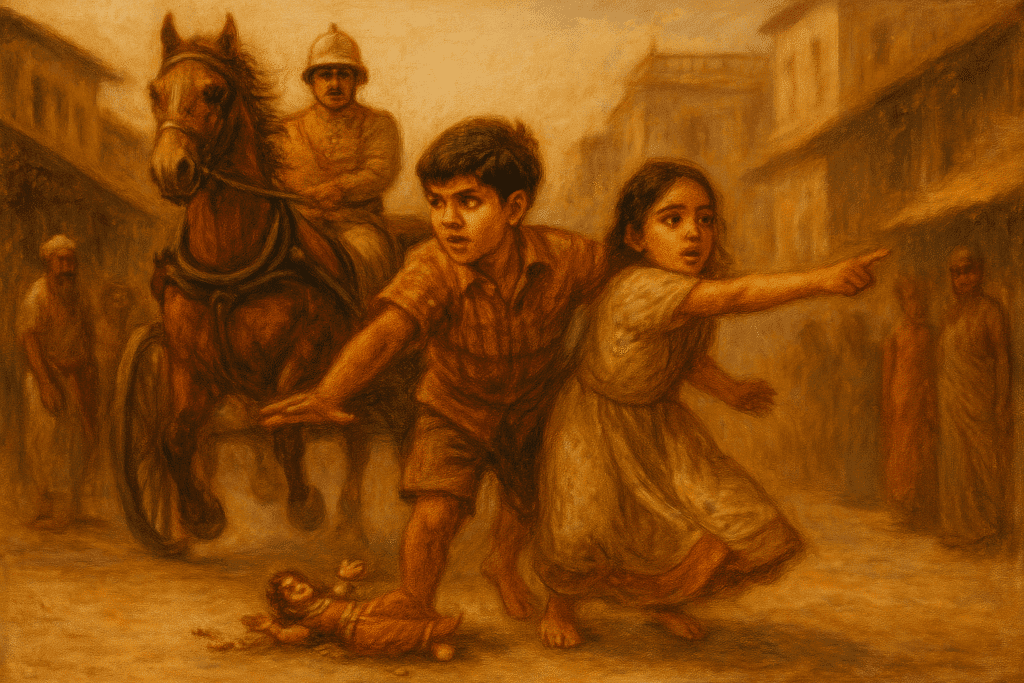
While the tale of Durga’s cosmic battle inspires awe, Navratri’s true spirit of courage and compassion transcends the mythological realm, manifesting in the human world. This is best captured in a powerful story from the childhood of one of India’s most revered figures, Swami Vivekananda, known then as Narendranath.
As a young boy, Narendranath bought a goddess idol from the local market to bring home. As he was returning, he saw a young girl, terrified and pushed to the ground, in the path of a rapidly approaching British carriage. In those days, British buggies and chariots wouldn’t stop for anyone, and the girl was in mortal danger of being trampled. Without a moment’s hesitation, Narendranath surged to her rescue. The girl was saved, but in his desperate rush, the idol fell on the ground and broke. Sad and still just a boy, he went home crying and told his mother the entire story.
That’s when his mother gave him a valuable lesson. She posed a profound question: “What is greater—the life of a child or an idol made of clay? We can buy a new idol if one is broken, but what about the life lost? In your haste to save her, the idol broke. But if you had not acted, the life of a living Goddess would have been crushed.” This belief would later become his most famous philosophical credo: “Service to Jiva (living beings) is service to Shiva (God).”
Imagine a boy getting such profound lessons from his mother in his childhood—he would one day embody the principle of “Simple living, high thinking,” and teach the world that service to humanity is the highest form of worship, and that true divinity resides within each of us.
This simple act and powerful insight perfectly encapsulate the deeper meaning of Navratri. It is a story of how a human being embodied the very courage and compassion that we celebrate in the Divine Mother. It challenges us to look beyond static rituals and understand that true divinity resides not just in temples and idols, but in our own actions—in the unwavering strength to protect the vulnerable and the courage to serve humanity. It teaches us that the ultimate victory of good over evil begins within our own hearts.
Navratri Across India: A Tapestry of Spirit and Celebration
Having explored the ancient legends and profound lessons, let’s now traverse the living landscape of India, where this festival bursts forth as a kaleidoscope of colour, rhythm, and devotion. For millions, Navratri isn’t just a spiritual observance—it’s one of the most awaited annual spectacles, blending faith, festivity, and economic vitality. According to the Confederation of All India Traders (CAIT), the Navratri–Durga Puja–Vijayadashami season is estimated to generate a massive trade of over ₹50,000 crore (approximately $6 billion USD) [1] [2], energizing retail, fashion, food, and tourism. It’s a time when the nation doesn’t just celebrate—it transforms.
The Grandeur of the East: Pandal Hopping in Kolkata
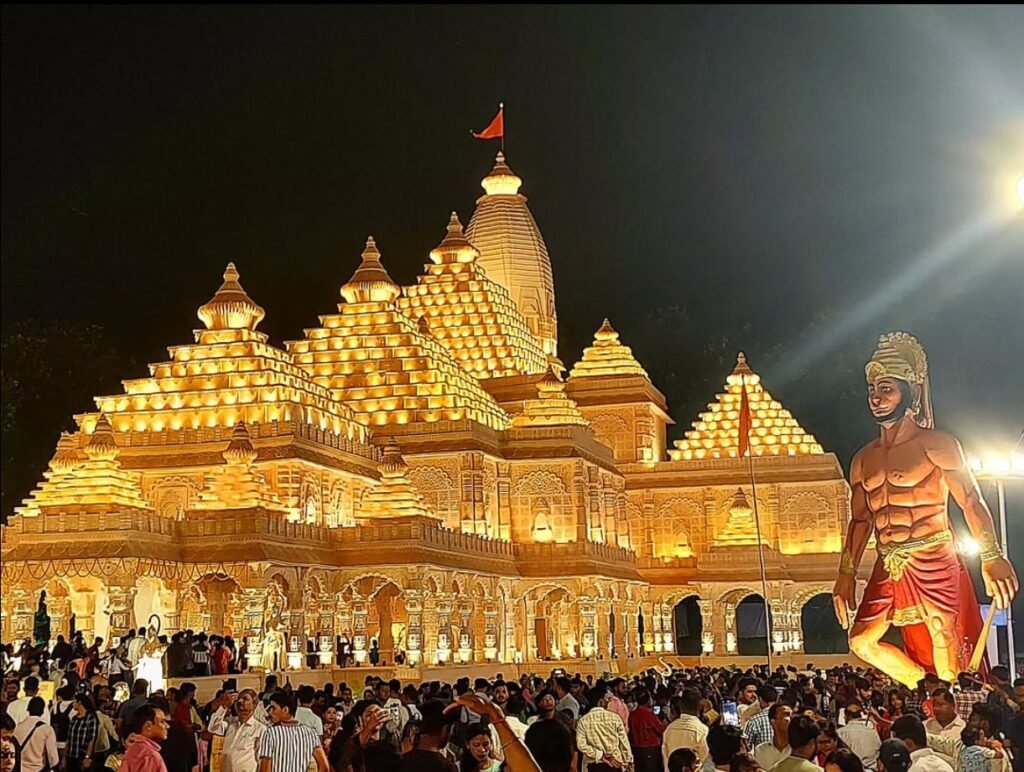
When you think of Navratri in Eastern India—especially in cities like Kolkata and Ranchi—what comes to mind isn’t just devotion, but a dazzling fusion of art, architecture, and collective spirit. Durga Puja here is far more than a religious ritual; it’s a full-blown cultural renaissance. Streets transform into open-air galleries, neighbourhoods become curators, and communities unite to create something truly extraordinary.
Take this image for instance: in 2024, a pandal modelled after the Ayodhya Ram Temple was erected in Ranchi. Yes, you read that right—a full-scale architectural replica, built not as a permanent monument, but as a temporary installation for Durga Puja. Can you believe it? Crafted with stunning precision and spiritual reverence, it stood tall for just a few days, only to be dismantled after the festivities. And this is just one among hundreds—each pandal a marvel, dotting the urban fabric of cities like Kolkata and Ranchi.
Months of meticulous planning go into these creations. Artists, engineers, sculptors, and volunteers collaborate to build breath-taking pandals that house exquisitely crafted idols of Goddess Durga and her divine entourage. These structures often replicate iconic landmarks, ancient temples, or even futuristic visions—each one a testament to human imagination and devotion.
As you stroll through the city during Puja, every few blocks unveil a new world. The idols of Durga slaying Mahishasura stand as radiant centerpieces—powerful, graceful, and awe-inspiring. The air is alive with the rhythm of dhak drums, the scent of bhog and street food, and the hum of shared celebration. On Vijayadashami, the grand Visarjan unfolds: idols are immersed in rivers and lakes, symbolizing the goddess’s return to her celestial abode. Just before this farewell, married women partake in Sindoor Khela, smearing vermilion on each other in a vibrant ritual of joy, sisterhood, and marital blessings. What remains is a lingering sense of devotion—and the quiet anticipation of her next arrival.
The Frenzy of the West: Garba and Dandiya Nights
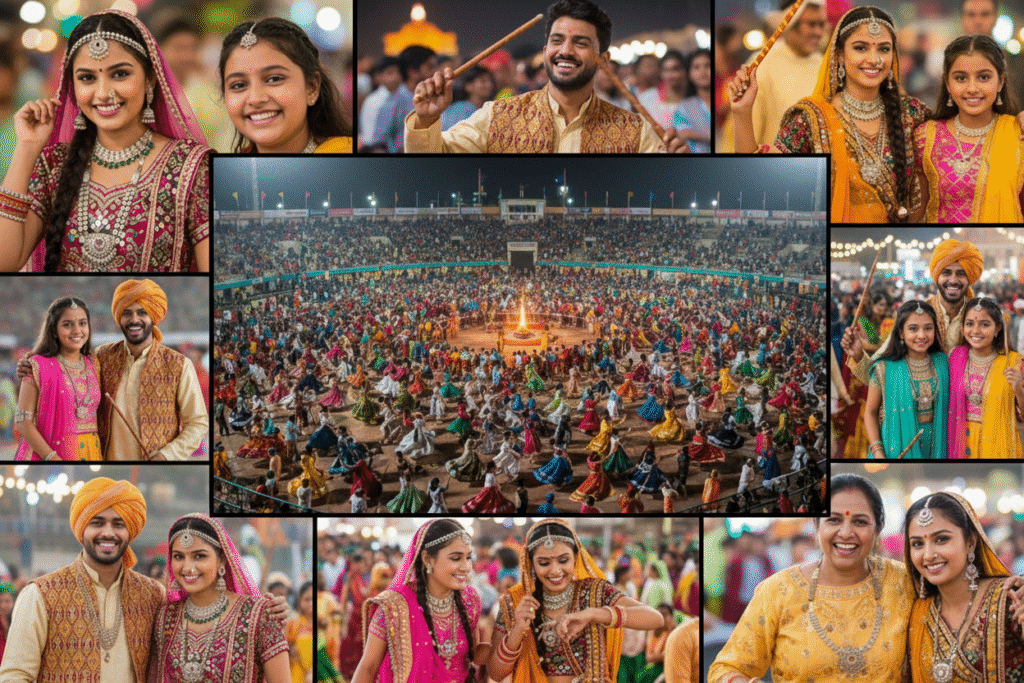
Around 1,900 kilometres west of Kolkata, in the vibrant state of Gujarat, Navratri takes on an entirely different, yet equally captivating, energy. Here, the festival isn’t just celebrated—it’s danced into existence. From Ahmedabad’s sprawling grounds to Mumbai’s community halls and seaside promenades—and even in faraway cities like London, New York, and Sydney—public spaces transform into colossal dance arenas that throb with spiritual and festive fervour.
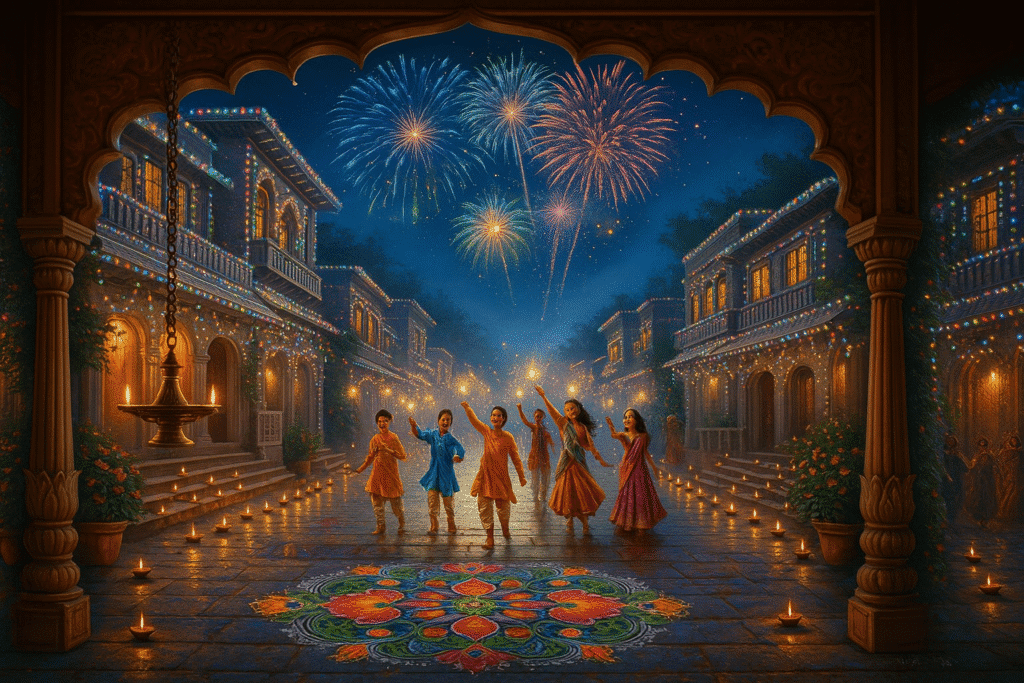
In this part of India, Navratri is synonymous with Garba and Dandiya nights—a radiant explosion of music, movement, and sheer joy that continues late into the night. The word Garba itself comes from the Sanskrit Garbh, meaning womb. This mesmerizing circular dance is performed with boundless enthusiasm around a centrally placed Garbha Deep—a clay pot with a lamp inside. In a deeply symbolic tradition, the pot represents the womb, and the lamp within it symbolizes life. The dance becomes a collective act of honouring all mothers, acknowledging them as the very source of creation.
By dancing around the Garbha Deep, women of the community not only pay homage to the Divine Mother but also seek her blessings for the health and well-being of all children. What a profound thought—that this vibrant tradition of dance and joy is rooted in a celebration of motherhood and the miracle of life.
Complementing Garba is the fast-paced Dandiya Raas, where dancers click decorated wooden sticks (dandiyas) together in a mock battle, symbolizing Durga’s fight against evil. The atmosphere is electric: pulsating music, swirling colours, joyous laughter, and the infectious energy of thousands moving in rhythm. It’s a powerful expression of devotion, community, and unfiltered zest for life.
The Spiritual Flow of the South and North
Beyond the towering pandals and pulsating dance floors, Navratri quietly flows into the rhythms of daily life across Southern and Northern India—where devotion is expressed through intimate traditions rooted in family and community.
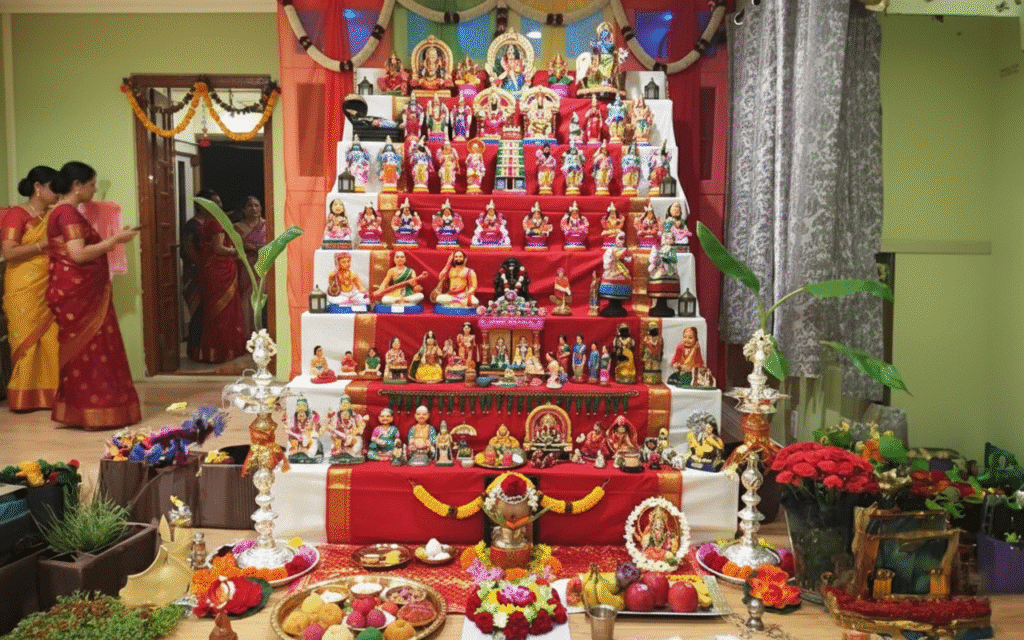
In the South, it blossoms into Golu (also known as Kolu or Bommala Koluvu)—a festival of dolls that transforms living rooms into miniature universes. Families arrange multi-tiered steps adorned with figurines of gods, goddesses, saints, and mythological scenes. But this isn’t just decoration—it’s a symbolic cosmos, a spiritual journey in clay and colour. Each display is an invitation to the Divine Feminine to grace the home, and the act of welcoming neighbours and friends to view the Golu becomes a celebration of shared faith, storytelling, and togetherness.
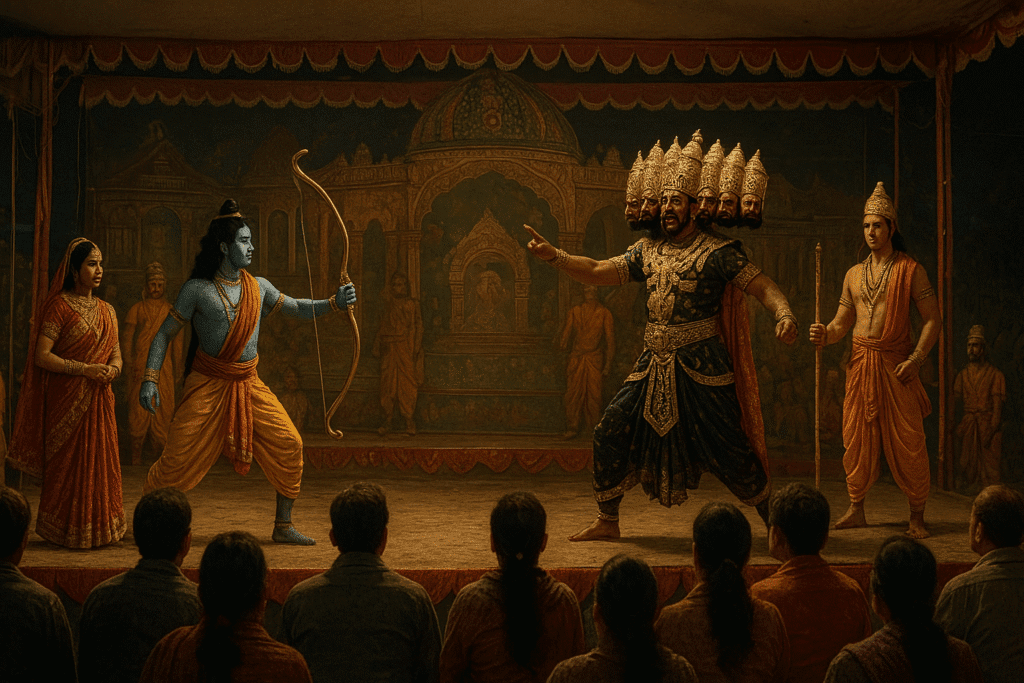
Meanwhile, in the North, the final days of Navratri shift toward the epic of Lord Rama. Communities gather for Ramlila—a dramatic retelling of the Ramayana performed under open skies. For nine nights, the saga of Rama’s exile, his battle with Ravana, and his triumphant return unfolds on stage. On Vijayadashami (Dussehra), the climax arrives with the burning of towering effigies of Ravana, Kumbhakarna, and Meghnad—an awe-inspiring spectacle of fire and fireworks that embodies the timeless message: good always triumphs over evil.
From the artistic brilliance of Kolkata to the kinetic energy of Gujarat, from the sacred doll displays of the South to the theatrical grandeur of the North—what binds these diverse expressions is the same radiant devotion to the Divine Mother. The festival is the same. The joy is the same. The soul of celebration is the same. Only the language of reverence changes, painting India in countless shades of faith and festivity.
Nine Days, Nine Hues:

While Navratri’s spiritual core remains timeless, a vibrant new tradition has emerged in recent years—one that blends devotion with visual storytelling. Across India and beyond, devotees now embrace a specific colour for each of the nine days, turning the festival into a living canvas of collective expression.
It’s a modern twist, yes—but one deeply rooted in meaning. Each hue corresponds to a form of the Divine Mother, reflecting her virtues through the language of colour. From the serenity of white to the fiery strength of red, these shades aren’t just fashion choices—they’re symbolic meditations worn with intention.
The colour grid above captures this beautifully: nine distinct tones, each paired with its corresponding date. Whether worn in sarees, kurtas, or even accessories, these colours unite communities in a shared rhythm of reverence, joy, and visual harmony.
Conclusion: Honouring the Shakti Within
From ancient legends to contemporary rituals, Navratri continues to echo a timeless truth: the triumph of light over darkness, courage over fear. Whether it’s the artistic brilliance of Kolkata’s pandals, the kinetic joy of Gujarat’s Garba, or the quiet devotion of South India’s Golu, each tradition is a living tribute to the Divine Feminine in all her forms.
But beyond the lamps, colours, and celebrations, the real journey is inward. Navratri invites us to awaken the Shakti within—to honour our resilience, intuition, and grace. Because the most profound victory isn’t just in slaying demons outside, but in recognizing the divine force that already lives within us.
Thank you for taking this journey with QuantiSoul—where tradition meets insight, and every story is a step toward deeper connection. Stay tuned for what’s next… the celebration continues.